

How to Choose a Real Estate Agent in 2026: The Data-Driven Australian Guide
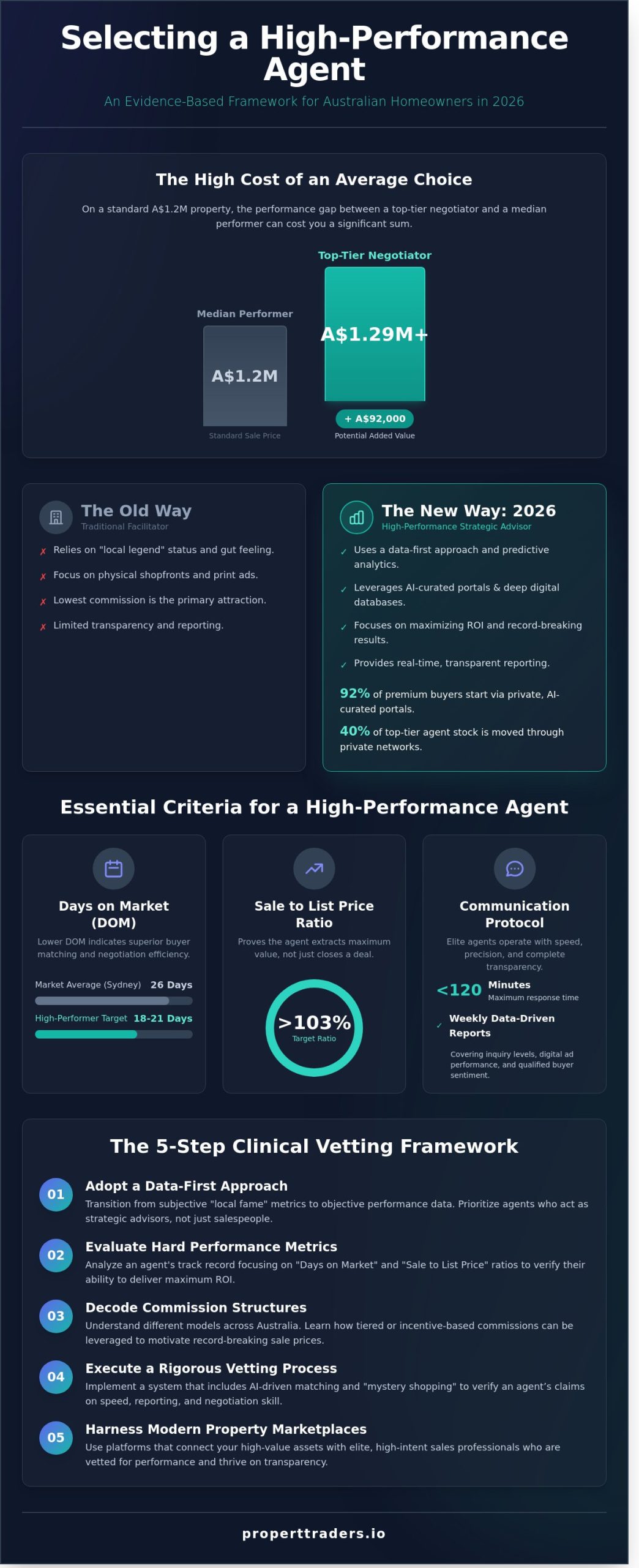
According to 2024 industry benchmarks, the performance gap between a top-tier negotiator and a median performer can cost an Australian homeowner upwards of A$92,000 on a standard A$1.2 million sale. Most vendors still rely on gut feeling or the lowest commission rate, yet data proves these metrics rarely correlate with a record-breaking result. You’re right to feel skeptical of smooth-talking sales pitches and conflicting appraisals that seem pulled from thin air. It’s frustrating when your largest financial asset is treated like a gamble rather than a calculated market play. Selecting the right real estate agent shouldn’t be a game of chance.
We provide the framework, you provide the final decision. This guide promises to transform your approach by showing you how to select a high-performance real estate agent using modern data, AI tools, and a rigorous vetting system. You’ll learn how to cut through the noise to achieve minimal days on market and transparent communication throughout the entire transaction. We’re moving beyond traditional intuition to give you a clinical, evidence-based strategy for securing a record-breaking price in the 2026 Australian market.
Key Takeaways
- Transition from traditional “local fame” metrics to a data-first approach that identifies agents acting as high-performance strategic advisors.
- Evaluate a real estate agent using hard performance data, focusing on “Days on Market” and “Sale to List Price” ratios to ensure maximum ROI.
- Decode complex commission structures across Australia and learn how tiered models can be leveraged to incentivise record-breaking sale prices.
- Execute a clinical vetting framework that includes AI-driven matching and mystery shopping to verify an agent’s speed, reporting, and negotiation skill.
- Harness the power of modern property marketplaces to match your high-value assets with elite, high-intent sales professionals who thrive on transparency.
The Evolution of the Australian Real Estate Agent in 2026
The role of the real estate agent has undergone a radical transformation. It’s no longer about who has the largest physical billboard on a Sydney street corner. Success in 2026 demands a transition from a simple facilitator to a high-performance strategic advisor. This new breed of professional operates like an institutional fund manager, prioritizing data-driven performance over traditional neighborhood fame. They don’t just list properties; they engineer outcomes using predictive analytics and sophisticated market positioning.
The “Old Way” relied on local notoriety and a massive physical shopfront. That model collapsed when digital reach became the primary driver of buyer behavior. By mid-2025, 92% of premium buyers in Sydney and Melbourne began their search through private, AI-curated portals before a property ever hit a public portal. The “New Way” focuses on transparency and AI-integrated property journeys. Clients now expect real-time reporting, instant feedback loops, and a level of digital sophistication that mirrors the high-stakes world of Property Traders. You provide the talent; the technology provides the edge.
Local expertise still carries weight in the Sydney, Melbourne, and Brisbane markets, but its definition has changed. It’s no longer about knowing where the best coffee is. It’s about understanding micro-market liquidity, zoning shifts, and the specific debt-to-income ratios of a suburb. In Sydney, where the median house price hovered around A$1.65 million in early 2026, the margin for error is non-existent. Agents who can’t interpret complex market signals are quickly replaced by those who can.
Why the “Local Legend” Status is No Longer Enough
Digital reach has officially superseded the physical shopfront. A 2026 industry survey revealed that 78% of high-net-worth sellers chose their real estate agent based on the depth of their digital database rather than their local office location. An agent’s digital footprint is their new resume. If you aren’t visible where the capital is moving, you don’t exist. “Off-market” capabilities have become the new benchmark for success. Top-tier agents now move 40% of their stock through private networks, bypassing traditional advertising costs and maintaining client privacy. This requires a level of database management that old-school “local legends” simply can’t maintain.
The Impact of 2026 Market Volatility on Agent Selection
Market volatility in 2026, driven by a 0.25% shift in RBA cash rates and fluctuating migration patterns, has separated the professionals from the pretenders. When the market is booming, anyone can sell a house. In a cooling or volatile market, “order-takers” fail because they lack the technical skills to handle complex objections. True “negotiators” thrive in these conditions. They understand how to bridge the gap between cautious buyers and ambitious sellers. They use data to justify pricing and leverage scarcity to drive competition. The Advisory Agent is a strategic consultant who utilizes real-time market data to secure client alpha in a volatile A$9.7 trillion national property market.
Essential Criteria for Selecting a High-Performance Agent
Selecting the right partner to move your assets requires more than a casual glance at a shopfront window. It demands a clinical analysis of performance data. High-performance agents operate like elite traders; they don’t guess, they execute based on market signals. When you vet a real estate agent, you’re looking for someone who treats your property as a high-stakes trade, not just a listing. You need a partner who understands that speed and precision determine your final ROI.
Start by auditing their track record with a focus on “Days on Market” (DOM). In competitive Sydney pockets like the Inner West or Lower North Shore, the average DOM hovered around 26 days in late 2023. An agent consistently hitting 18 to 21 days demonstrates superior buyer matching. Pair this with their “Sale to List Price” ratio. You want to see a ratio exceeding 103%, proving they don’t just close deals, they extract maximum value from the market. Compliance and ethics also matter, so ensure your candidate maintains a clean record with NSW Fair Trading to avoid regulatory friction during the settlement process.
- Communication: Demand a response time under 120 minutes. High-performers provide weekly data-driven reports covering inquiry levels, bounce rates from digital ads, and qualified buyer sentiment.
- Marketing Strategy: Look for a digital-first approach. Traditional print is a legacy cost. Effective agents leverage targeted social media algorithms and premium portal placement to reach the 88% of buyers who search via mobile apps.
- Negotiation Style: Ask for three recent examples where they secured a price A$50,000 above the buyer’s initial “walk-away” limit. They must demonstrate the ability to create urgency without appearing desperate.
Decoding Agent Performance Metrics
Don’t let a long list of “Recent Sales” distract you from the quality of those transactions. You must distinguish between “Volume Agents” and “Value Agents.” Volume agents prioritize turnover to fund their own overhead, often leaving 5% of your potential profit on the table to secure a quick exit. Value agents focus on the margin. Ask for a clearance rate specific to your suburb over the last 180 days. A generic city-wide clearance rate is useless data. You need to know how they perform in your specific street or building type to gauge their true leverage. If you’re looking for a deeper dive into the vetting process, check out our guide on How to Find the Best Real Estate Agent in Sydney.
The Role of Local Suburb Knowledge
Local expertise is an undervalued asset in a high-interest-rate environment. An elite real estate agent knows that being 100 metres inside the catchment for a school like Killara High or Sydney Secondary College can add A$200,000 to the baseline value. They track infrastructure shifts, such as the progress of the Sydney Metro West project, and use these data points to build a “buyer profile” that targets high-intent investors rather than time-wasters. This granular knowledge allows them to pivot their pitch based on real-time local shifts. This level of precision is exactly how top-tier professionals approach scaling your real estate portfolio through smarter partnerships. Every suburb has its own rhythm; your agent needs to be the one setting the beat.
Comparing Commission Structures and Marketing Fees
Mastering the financial mechanics of a property sale is what separates a top-tier real estate agent from a standard facilitator. In the Australian market, commission rates are not uniform; they reflect the specific risk and demand of each state. New South Wales averages between 1.5% and 2.5%, while Victoria typically sits between 1.6% and 3%. Queensland, which has been deregulated since December 2014, often sees rates ranging from 2% to 3.5% depending on the property’s location and price bracket. These figures represent the cost of professional expertise and market access.
To maximize results, elite performers utilize a tiered commission model. This structure sets a base percentage up to a specific “strike price” and a higher percentage for any amount achieved above that threshold. For example, an agent might charge 2% on the first A$2,000,000 and 10% on every dollar thereafter. This aligns the agent’s profit motives directly with your goal of achieving a record-breaking sale price. It transforms the relationship into a high-stakes partnership where every extra dollar found in the market benefits both parties.
The most common objection in a booming market is: “Why should I pay 2% when the house sells itself?” This mindset confuses a “sale” with a “result.” A house might sell for A$1.8 million with zero effort, but a skilled real estate agent creates the competitive tension required to push that figure to A$2 million. You aren’t paying a commission to find a buyer. You’re paying for the negotiation leverage that extracts the maximum possible capital from the pool of interested parties. In a high-velocity market, the cost of a poor negotiator is always higher than the cost of a premium commission.
Fixed Fee vs. Percentage-Based Commissions
Fixed fee models offer budget certainty, which appeals to sellers of ultra-high-value assets exceeding A$10 million. However, this model often lacks the performance-driven “scaling plan” inherent in percentage-based structures. Percentage-based models scale with the market’s appetite, ensuring the agent remains motivated until the final contract is signed. Low-commission models create an incentive gap where the agent is encouraged to prioritize a high volume of quick turnovers rather than fighting for the highest possible price for your specific asset.
Understanding Your Marketing Budget (VPA)
Vendor Paid Advertising (VPA) is the fuel for your property’s visibility. By 2026, a “Premiere” listing on major Australian portals for a standard 30-day campaign in a metropolitan area can cost between A$8,500 and A$14,000. This is a non-negotiable cost of entry for reaching 95% of active buyers. Professional staging for a typical four-bedroom home currently averages A$5,500, while high-end cinematic videography adds approximately A$1,500 to the budget. These are not expenses; they are strategic investments designed to increase the perceived value of the property instantly.
- Portal Dominance: High-impact listings on major sites are essential for capturing interstate and international interest.
- Visual Assets: 83% of buyers cite high-quality photography as the primary reason they book an inspection.
- Risk Mitigation: Negotiate a “no-sale, no-fee” marketing arrangement to ensure the agency shares the financial risk of the campaign.
Successful sellers treat marketing as a calculated deployment of capital. When you provide the asset and the marketing budget, you are empowering the agent to execute a high-performance strategy. This professional synergy ensures that your property doesn’t just sit on the market but dominates it. Demand transparency in every line item of the VPA quote to ensure every dollar spent is optimized for maximum lead generation and buyer engagement.
The Step-by-Step Vetting Process for Property Owners
Selecting the right partner to sell your asset requires more than a gut feeling. It demands a data-driven approach. Start by shortlisting three candidates using the Property Traders AI-powered marketplace. This platform analyzes performance metrics from the last 180 days, focusing on median sale prices and average days on market across Sydney’s competitive postcodes. By utilizing this technology, you eliminate the emotional bias that often leads to poor hiring decisions. You need a real estate agent who operates with the precision of a high-frequency trader, not someone who relies on outdated local fame.
The Mystery Shop: Testing the Agent in the Wild
Walk into one of their current open homes unannounced. This is your primary data collection phase. Don’t reveal your identity as a potential vendor; act as a buyer with a difficult set of requirements. Observe how they handle the crowd. A top-tier professional captures lead data from 100% of attendees before they exit the foyer. If they’re too busy chatting to notice a new face, they’re losing you money.
Pay close attention to their follow-up protocol. Statistics show that 74% of active Sydney buyers expect a phone call or digital property pack within 4 hours of an inspection. If the agent waits until Tuesday to contact you after a Saturday open house, their “Buyer Management” is flawed. This lack of urgency will directly impact your final sale price. You want an agent who treats every lead like a high-stakes trade entry.
The Final Interview: Questions that Cut Through the Noise
Move past the generic sales pitch. You’re interviewing for a high-performance position, so demand clinical clarity. Ask these three targeted questions to reveal their actual market leverage:
- “What is your specific strategy for a buyer who offers 10% below asking price in the first week?” Look for a scripted negotiation framework, not a vague promise to “work them up.”
- “How many active buyers are in your database for this suburb right now?” A high-performer should quote a specific number, such as 4,200 verified contacts, and explain their segmentation strategy.
- “Show me a case study of a property you sold that struggled for more than 35 days.” Success is easy in a boom; you need to see how they pivot when the initial “Scaling Plan” fails.
A professional real estate agent will welcome this scrutiny. They understand that transparency is the foundation of meritocracy. If they can’t provide a 12% increase in engagement through tactical marketing shifts, they aren’t the right fit for your portfolio.
The final step involves checking references with a critical eye. Don’t just ask if the previous vendor was happy. Ask about the final 5% of the negotiation. Did the agent push for the extra A$20,000 when the deal was already “good enough”? Contact a vendor from a sale completed in the last 90 days to get an accurate read on current market temperament. This disciplined vetting process ensures that when you finally commit, you’re backed by the best talent in the industry.
Unlock the potential of your property by partnering with a verified high-performer today. Access the Property Traders marketplace now to shortlist your top three agents.
Leveraging AI to Match with the Right Real Estate Professional
Property Traders utilizes proprietary machine learning algorithms to bridge the gap between motivated property owners and high-performing agents. This isn’t a basic directory search. Our AI engine analyzes over 15 distinct data points, including local clearance rates, median days on market, and historical auction success, to identify the ideal real estate agent for your specific asset class. By processing thousands of Sydney market transactions, the platform identifies patterns of success that human intuition often misses. This data-driven approach ensures that owners connect with professionals who possess a proven track record in their specific suburb and price bracket, rather than just the agent with the largest billboard budget.
The traditional referral model in Australian property is frequently clouded by “referral kickbacks” and “old boys’ club” networks. These hidden fees, often reaching 20 percent of the total commission, create a conflict of interest that serves the middleman rather than the vendor. Property Traders removes this human bias entirely. Our marketplace operates on a meritocratic framework where performance metrics dictate visibility. We’ve eliminated the opaque handshake deals of the past, replacing them with a transparent ecosystem where the only currency that matters is results. This ensures your property journey begins with a partnership built on technical competence and strategic alignment.
Your Talent, Our Capital: The ProperTraders Advantage
We operate with an elite and accessible mindset. We believe that when you combine the right professional talent with sophisticated market capital, the results are exponential. Our Professional Dashboard empowers owners to track performance in real-time, providing a level of oversight previously reserved for institutional investors. You gain access to a scaling plan for your property portfolio, utilizing tools that clarify risk management and maximize potential equity. It’s a disciplined approach to wealth creation that rewards consistency and market intelligence. Join the Property Traders Marketplace and find your agent today to unlock the full potential of your real estate holdings.
The Future of Real Estate is Transparent
The 2026 consumer won’t tolerate delayed responses or vague performance claims. They demand instant data and absolute accountability. Our AI property matching reduces the time spent on “bad fits” by 65 percent, allowing you to bypass the endless cycle of unproductive interviews. By 2026, we anticipate that data-backed matching will be the industry standard for every serious real estate agent in the Sydney metro area. This shift toward digital transparency isn’t just about efficiency; it’s about control.
Taking control of your financial future requires a partner who values transparency as much as you do. We provide the infrastructure and the analytical tools, but your property is the catalyst. Don’t leave your most significant financial decision to chance or outdated referral networks. Embrace a system designed for the modern market, where talent is recognized, performance is measured, and success is shared. Start your journey with a platform that treats property with the clinical precision of a high-stakes financial market, ensuring you move forward with the confidence of a seasoned trader.
Secure Your 2026 Property Advantage
Navigating the Australian property market in 2026 requires a shift from gut feeling to hard data. You’ve seen how top-tier vendors now utilize AI matching to identify high-performance partners who command local market shares above 15% in Sydney, Melbourne, and Brisbane. Success hinges on a 5-step vetting process that prioritizes transparent performance analytics over the lowest commission. Choosing a real estate agent is no longer a search for a salesperson; it’s a strategic hire for your most significant financial asset.
ProperTraders empowers you with the same institutional-grade insights used by Australia’s elite property investors. Our platform connects you with professionals who have a proven track record of exceeding suburb medians by an average of A$45,000. We provide the tools, you provide the talent. It’s time to take control of your equity and scale your results with professional confidence. Find a Vetted Real Estate Agent on Property Traders
Your property deserves the precision of a data-backed strategy. Start your next chapter with the certainty that only elite performance can provide.
Frequently Asked Questions
What is the average real estate agent commission in Australia in 2026?
The average real estate agent commission in Australia for 2026 is projected to sit at 2.1% of the final sale price. In highly competitive zones like the Sydney Metro, rates frequently compress to 1.8%, while regional markets often maintain levels closer to 2.6%. These figures represent the professional fee for service and typically exclude GST and marketing expenses. You’ll find that performance-based tiers are now the standard for elite negotiators who deliver results above the reserve price.
Can I negotiate the marketing fees with my real estate agent?
You can absolutely negotiate marketing fees because these costs are separate from the agent’s commission. Expect a standard Sydney campaign to range between A$4,500 and A$12,000 depending on the media mix and property value. Request a line-item breakdown of the Vendor Paid Advertising (VPA) to see exactly where your capital is going. High-performing agents often offer flexible packages that align with your specific liquidity and property exposure goals.
How do I know if a real estate agent is lying about their database?
Verify a database by requesting a “Hot Buyer” report showing the number of active, qualified leads registered in the last 14 days. A transparent real estate agent will demonstrate their CRM’s capability by matching your property’s specific attributes against buyer profiles instantly. Don’t settle for vague claims of “thousands of buyers” in their system. Demand a 48-hour test where they present three specific, verified profiles that match your property’s price bracket and suburb.
Is it better to use a local boutique agency or a large national franchise?
Choose based on your property’s unique requirements and the individual agent’s 12-month track record. Boutique agencies often provide 20% more direct principal involvement, while national franchises leverage 500+ office networks for interstate referral traffic. Your success depends on the specific agent’s skill set rather than the logo on the sign. Evaluate their recent 90-day clearance rate and their ability to articulate a clear risk management strategy for your sale.
What happens if I sign an exclusive agency agreement and the property doesn’t sell?
You remain bound to that agent for the duration of the exclusivity period, which is typically 90 days in New South Wales. If the property remains unsold after this term, you can terminate the agreement in writing without paying a commission fee. You’re still responsible for any pre-agreed marketing costs incurred during the 90-day campaign. Always check your contract for a “continuing agency” clause that might extend their rights beyond the initial term.
How does an AI marketplace like Property Traders actually find me an agent?
Property Traders uses a proprietary algorithm to match your property data against 25+ specific performance metrics from local operators. We analyze recent sale prices, average days on market, and list-to-sell ratios to identify the top 3% of performers in your suburb. This data-driven approach removes emotional bias and focuses purely on a real estate agent who delivers consistent ROI. Your property deserves elite representation backed by hard evidence and market-leading technology.
What are the red flags to watch for when interviewing a real estate agent?
Watch for “buying the listing,” where an agent quotes a price 10% higher than recent comparable sales just to secure your signature. A low commission rate under 1.6% is another red flag, as it often indicates a lack of negotiation skill or a high-volume, low-service business model. Professional agents provide a 12-month suburb performance report and a clear strategy for managing market volatility. Avoid any agent who cannot provide three recent vendor references from the last 60 days.